 Xerendipity has something new at MWC, a stick-on vapor chamber called the Vapor-Pad. Of all the things SemiAccurate was expecting at the show, the Vapor-Pad wasn’t among them.
Vapor chambers are a big, somewhat bulky item that generally need to be made for a specific use case, both for thermal performance reasons but also for size and fit. Many devices use them, they work well, and are not considered exotic in any way. There are other ways to do the same job with tradeoffs on cost, effectiveness, and size as well but Xerendipity seems to occupy a pretty unique space with their Vapor-Pad. And their non-metal vapor chamber, but more on that later.
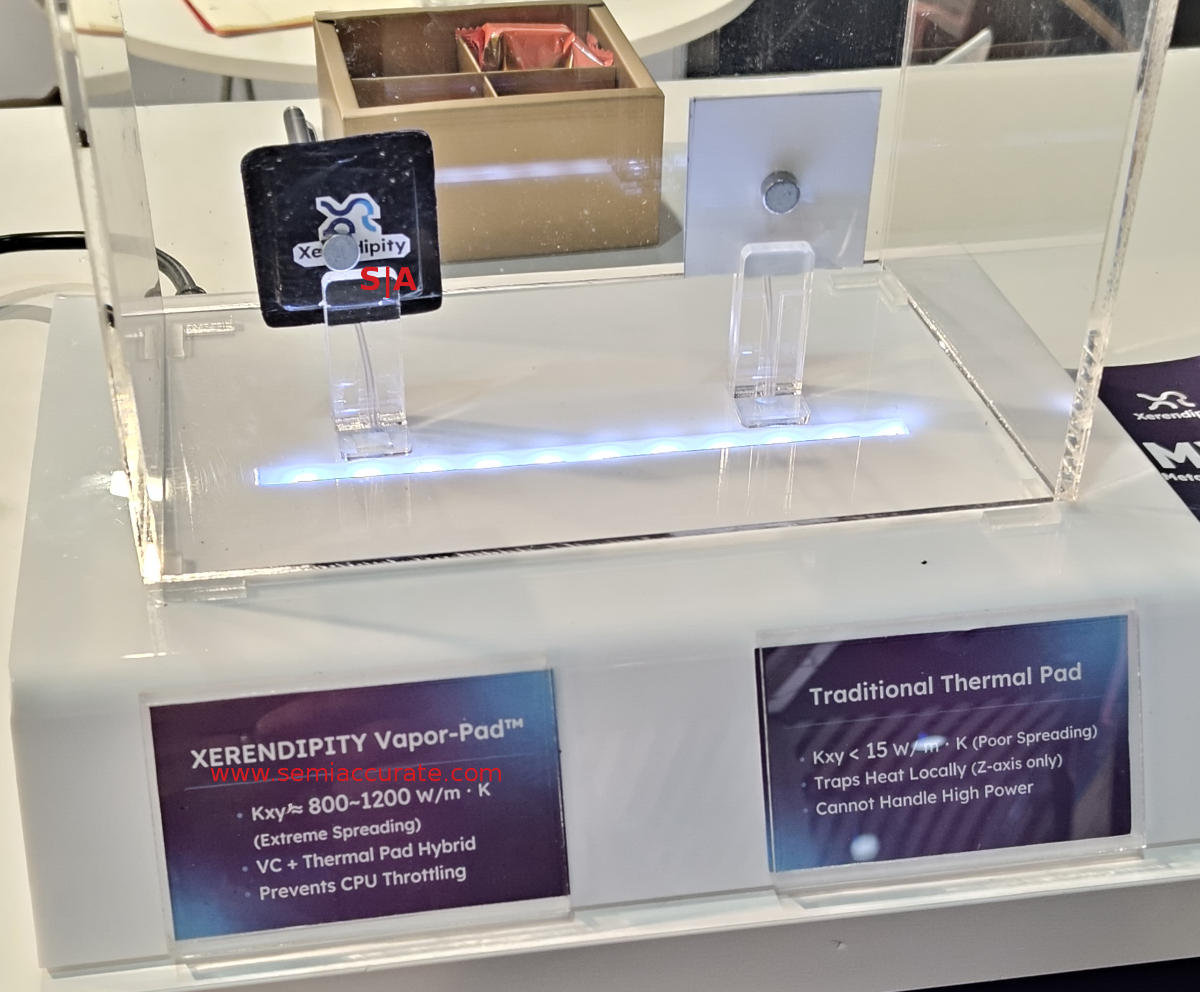
Vapor-Pad sticker beside a normal thermal pad
As you can see, the Vapor-Pad is basically a sticker with a vapor chamber on it, think puffy plastic stickers for children but metal and highly engineered for thermal reasons. No googly eyes here although that might sell a few more. Unfortunately due to trade show logistics and bad timing, SemiAccurate wasn’t able to get the full brain dump on the products but we did get enough to realize that this is a really good idea.
According to Xerendipity, a normal cooling pad like the one on the right above has a thermal spreading coefficient between 800-1200 W/m*K vs about 15 W/m*K for normal thermal pads. Obviously there are a bunch of solutions that fit between these two points but two orders of magnitude or so is a pretty solid gain. But why would you use them?
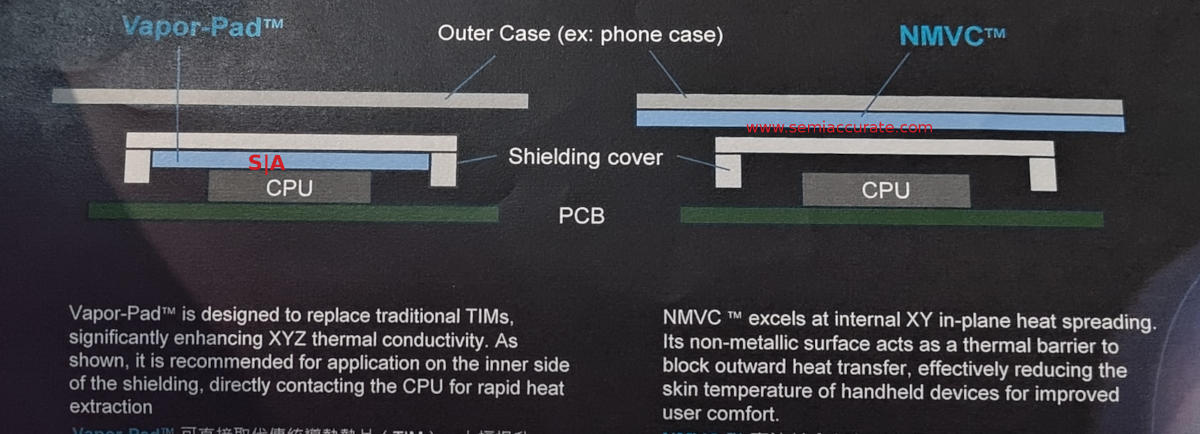
Uses of the Vapor-Pad and Non-Metal Vapor Chamber
Xerendipity pictures the vapor pad going between a CPU and the metal slug on top, basically where the thermal paste or solder TIM goes. If their numbers are correct, this would basically eliminate hot spots on the slug and do a lot for cooling the CPU itself. We can’t say how well it works but in theory it is a good thing that would be very useful in high performance applications.
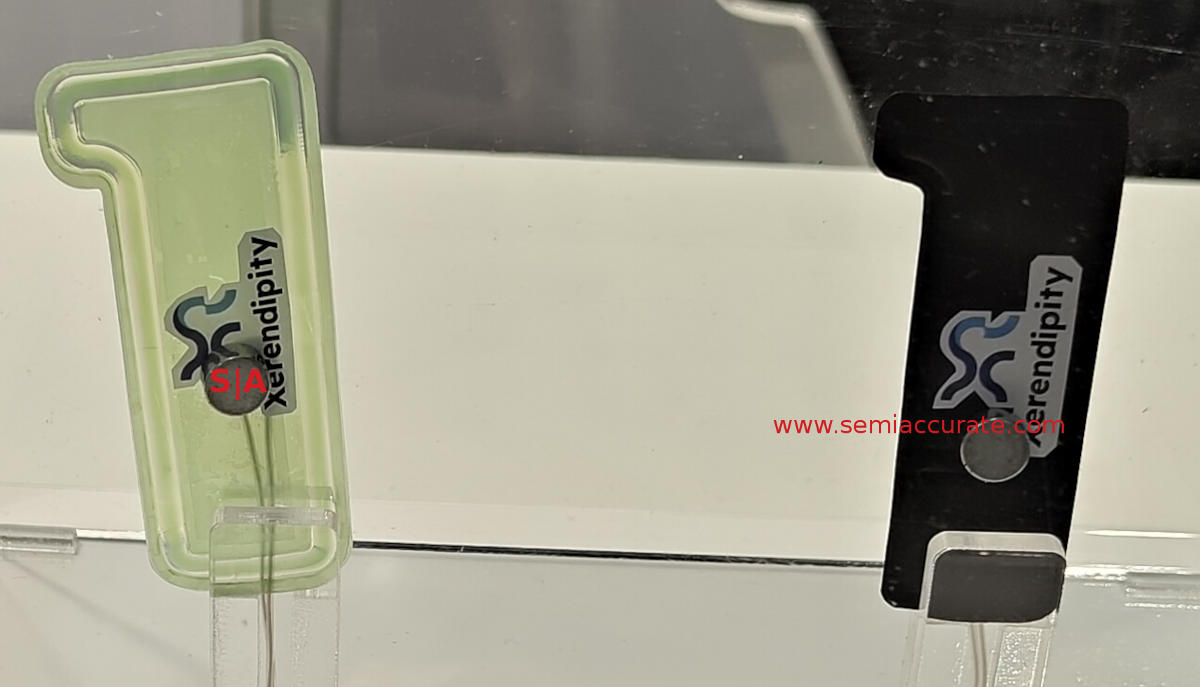
Non-Metal Vapor Chambers come in at least two colors
You may notice the diagram on the left of the slide has the term NMVC on top of the CPU cover rather than below it like the Vapor-Pad. That is the non-metal vapor chamber mentioned before and pictured above. What is it? Sit down for this explanation but it is a vapor chamber made of non-metal materials. Bet that one took you by surprise.
But why would you care about metal or non-metal in your vapor chamber, especially since the non-metal one is only has about 90% the performance of a metal one? It will be buried under the heatsink/fan on a PC or under the case on your phone. On a PC or server, you wouldn’t care. On a phone however, there is one additional quality that makes it a clean kill for some phone applications, a claimed 100% signal pass through for 5G and Wi-Fi frequencies.
Metal or carbon fiber mats have this annoying tendency to not be as transparent to radio signals, a fact that makes engineering phones a bit tricky. Take a look at the edges of your phone, notice the bands of different material around the sides, usually five or more per phone. Those are the cutouts in the metal rim where the antennas communicate. If you look at our ROG9 writeup, you can see the vapor chamber, metal, that would block the signals nicely. It also shows why you need to engineer a specific solution per device quite nicely.
With a NMVC, you could theoretically line the entire case with a vapor chamber and end the concept of hot spots almost entirely. This is of course space and cost dependent but at least you won’t have to worry about aggravating your RF engineering team, they are twitchy enough already. One thing you won’t have to worry about is weight, Xerendipty claims that the NMVC is 80% lighter than copper solutions so you can save a few precious grams and cool better.
In the end, Xerendipity has two interesting products. The idea of a sticker that is a vapor chamber operating at ~2 orders of magnitude higher performance than a traditional solution does sound useful. The NMVC however is potentially more useful in the phone space. If you could line large areas of your device with a vapor chamber and not block signals, that has potential. In any case we saw not one but two things we were not expecting at MWC this year.S|A


Charlie Demerjian
Latest posts by Charlie Demerjian (see all)
- Zerendipity Shows Off Stick-On Vapor Chamber - Mar 13, 2026
- AI PCs Have Failed Miserably, Can We Just Admit It? - Mar 11, 2026
- Adata Shows Off Quad-Ranked DDR5 CUDIMMs At High Speed - Feb 13, 2026
- Qualcomm Desperately Tried To Hide Snapdragon X2 Elite Power Use - Feb 11, 2026
- Cybersight Does Biking Glasses Right With Zenith - Feb 9, 2026
