 Intel is celebrating the 20th anniversary of the vPro launch with a few new goodies. SemiAccurate is celebrating the author launching vPro for Intel 20 years and a few days ago.
OK, snide comments aside, I launched the vPro brand for Intel a few days before they did on the Sunday before Spring 2026 IDF. No really, I am not joking, the original on The Inquirer may be long gone but the always amazing Wayback Machine on the Internet Archive has the backup. Thus ends the history lesson, on with the show.
Looking over the launch materials, one thing is clear, Intel is very keen to talk about vPro and AI as a lifestyle choice but doesn’t really want to talk about the technology or the devices. Some of this we managed to peel out to them but there are far too many blanks left so forgive us if we don’t have the details because, well, we don’t have many of the details. That said there was a lot of good at the launch, lets cover what we can starting with the really good.
Intel did a spectacular job with the footnotes and details, they put in the stuff we need to verify the claims, or at least go a long way towards it. This is the polar opposite of Qualcomm and to a lesser extent AMD who actively hide questionable claims by not providing details either in the presentation or when directly questioned afterwards. Intel had *14* pages of fine print and footnotes on an 85 page deck, they may have missed things but the overwhelming majority is there. Take note Qualcomm.
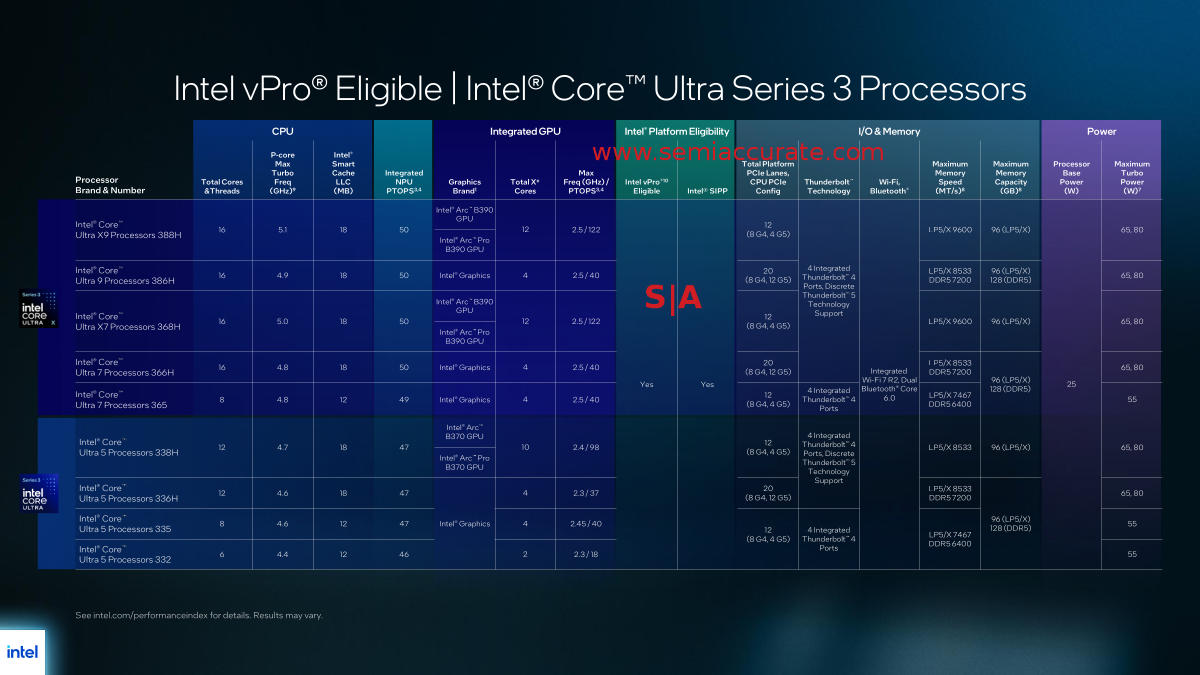
Either 5 or 9 new vPro CPUs
Back to the actual information, lets start out with the chips themselves, welcome to the new Intel vPro Eligible Intel Core Ultra Series 3 Processors or IvEICUS3P for… err… short? Anyway take Panther Lake CPUs, load the vPro firmware onto them, and off you go. The new naming is Ultra X# and there are five new CPUs, two X9s and three X7s. That said after doing so well on the fine print, Intel reverted to a “Total Cores & Threads” count. This is BS, stop.
Below those there are four Ultra 5 branded CPUs, the 338H, 336H, 335, and 332 all of which are not Ultra X branded. This means they are not vPro or SIPP eligible but for some reason appear on the slide entitled “Intel vPro Eligible”. No we can’t explain that either.
Heterogeneous cores are a terrible idea in laptop and PC form factors, the software complexity and fragility that it takes to run them is just not worth it for a meager few minutes of battery life gained. Things rarely work right and almost always break with the next OS point revision. It is just dumb, and covering for the lack of SMT (Hi Lion team…) just makes the silicon problems more obvious. By that nomenclature AMD has 32 “Total Cores & Threads”, not a fight you want to pick.
All this said, Panther is a very good CPU, it has great graphics, power usage, and no obvious glass jaws. It is up against a barely warmed over AMD lineup so it should be a very one sided fight. Unfortunately Panther is nowhere on the market, for practical purposes it doesn’t exist as of this writing. At MWC SemiAccurate shot down rumors that this supply crisis was due to 18a/yield issues, it categorically is not, nor is it due to a rumored bug from QS to production steps. Intel would not shed any light on what was going on, but we did ask. When Panther hits in volume, it should be a damn good part.
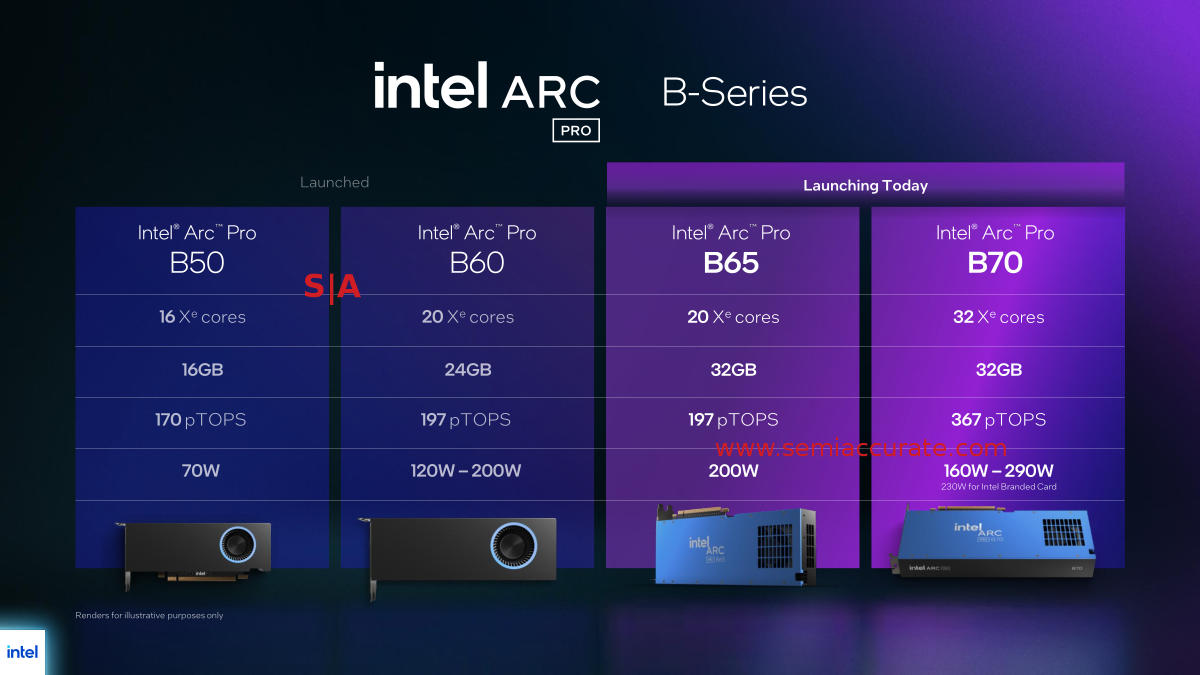
Intel Arc Pro B-Series lineup
More good silicon news comes via two new Arc B-Series GPUs, the Arc Pro B65 and B70. Of the two the B65 is the least interesting, take the current B60 and bump up the RAM from 24GB to 32GB. This may not sound like a big deal but for AI use cases, you know the only market companies seem to think is relevant any more, it is probably the most important metric. The B70 also has 32GB but it bumps up the shader cores from 20 to 32. For the record, the B70 is new silicon but there aren’t major changes, it is just ‘more’ of the current B-Series GPUs. We can’t shed any more light on it though.
Performance maxes out at 367 TOPS for the B70, 197 for the B65 which should tell you the big chip also runs a bit over 16% higher clocks. Those slides at the very end say that the B65 runs at 2400MHz and the B70 at 2800MHz so there you have it. More important is that the B65/70 has ECC, real ECC not Nvidia fake ECC. Go count the chips on their CPU+GPU devices and cringe at the performance and power Nvidia left on the table presumably to pinch pennies. Intel for some reason did the right thing for the right reason here.
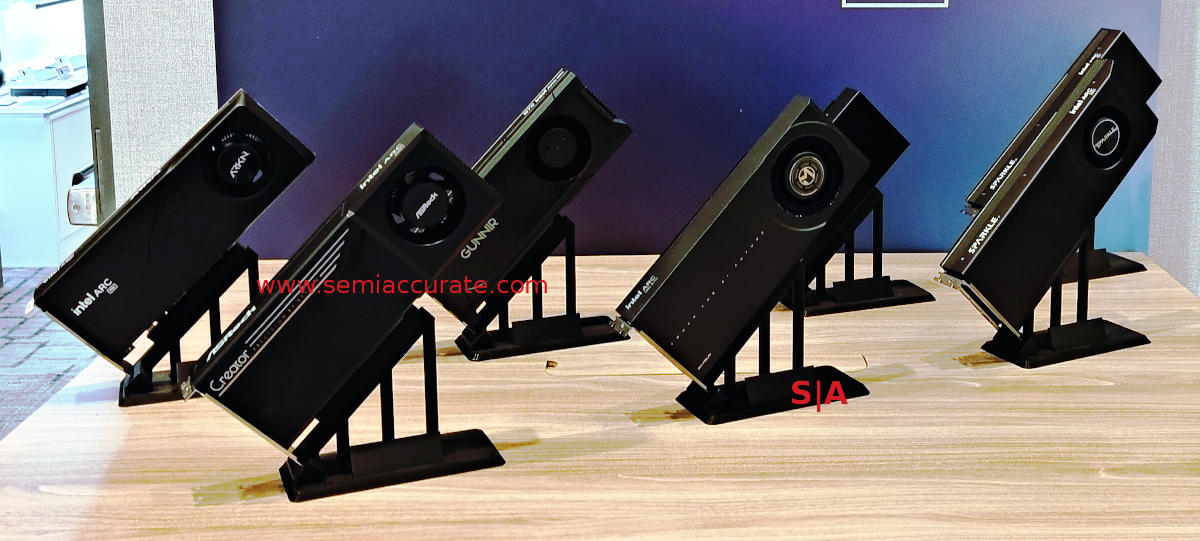
Partners do things a bit differently
The B70 from Intel is priced at $949, a pretty solid price for a device with these capabilities. Prices for the ODM variants will probably be all over the map but the Intel price is likely the high water mark. The B65 is ODM only so there is no official MSRP, think lower by a good chunk. Intel showed off seven cards with both active and passive cooling, and the slides show a range of wattages from 160-290W so expect real variation in the market. When was the last time you could say that about a ‘Pro’ card?
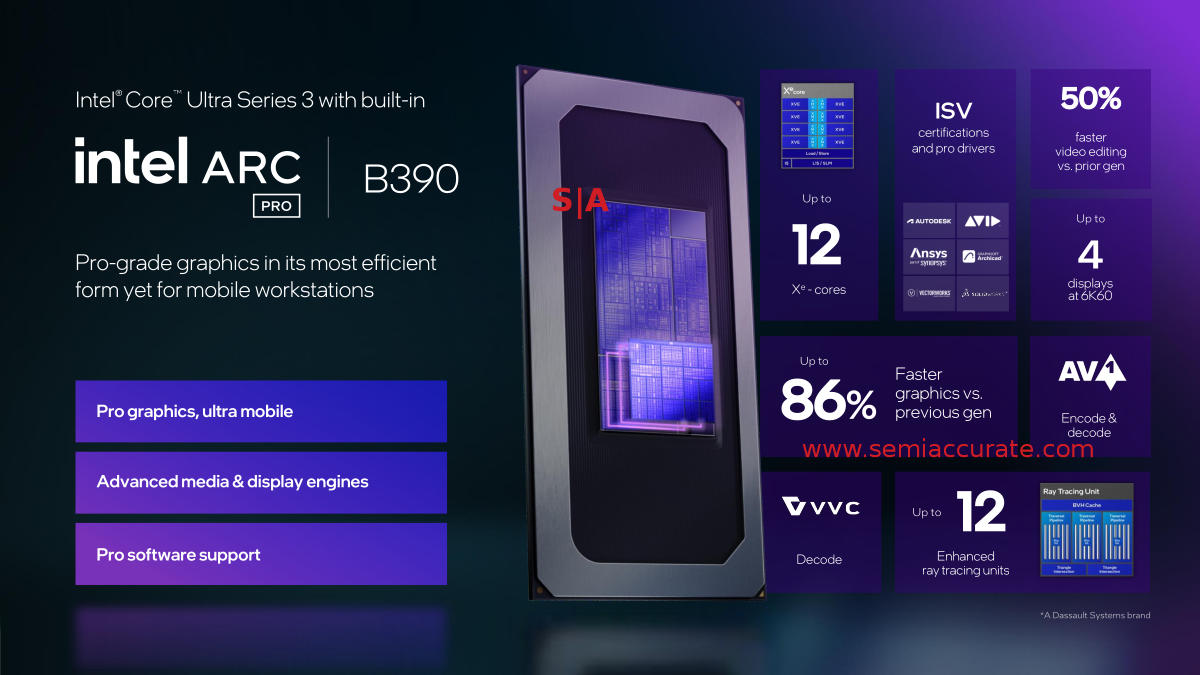
Arc Pro comes embedded too
Combing the two silicon pieces is the big -H suffix Panther Lake CPUs. Those with the full 12 Xe cores should be pretty powerful, you are getting 60% of the biggest discrete GPU that Intel had before today. The decoder ring says that H = 12 Xe cores, no -H suffix = 4 cores so that letter on the 366 is is likely a typo. Those GPUs with the full core complement can come in both ‘Pro’ and amateur variants of the Arc B390 branding as well. The smaller Ultra 5 CPUs sport the Arc B70 branding, have an -H suffixed part with 4 cores, and come in both Pro and amateur versions. These new Series 3 CPUs should be pretty damn powerful in GPU oriented tasks, don’t ignore that side of the offering.
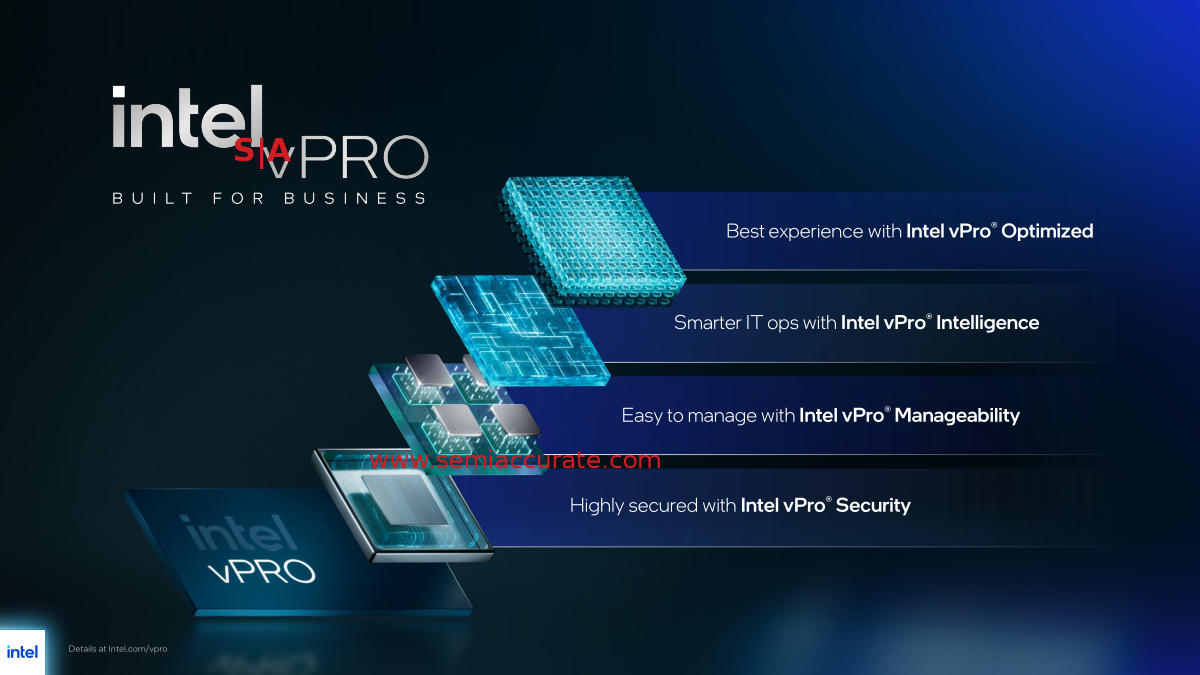
Pillars of the new vPro lineup
For this launch, Intel had four pillars of vPro to stand on, Optimized, Intelligence, Manageability, and Security, all prefaced with “Intel vPro” officially. We will ignore that from here on out for our and your sanity. Some of these things are really good but others fall into the category of Window dressing, capitalization intentional. Lets take a look at each, some in more depth than others.
Under Optimized there are two new things, a vPro Certified Apps & Accesories Program plus an enhanced commercial connectivity program. The enhanced commercial connectivity program is easy enough, enhanced means it now supports Wi-Fi 7 R2 and Bluetooth Core 6.0, coincidentally things that Panther supports too. What a lucky piece of alignment there, but we can’t deny the usefulness of the new standards support.
The vPro certified apps and accessories is a bit harder to understand, at least the reasons behind it. Ostensibly it means better drivers, better ability for IT to diagnose issues, and more stability. The initial products are nice though, as this is written the background music is being played through a Logitech Zone Wireless 2 ES for Business. After about an hour of use seem pretty solid so far but an hour or two is not long enough to come up with a real view on hardware like this. That said the laptop they are connected to, an Asus Zenbook S14/Lunar Lake is not vPro so, well it just works.
Intel said we would get a list of what Intel certifies the apps and devices on/for but as of this writing we haven’t seen it. It is most likely a superset of what Microsoft does so badly with drivers but there might be something interesting there that we are not aware of. In any case we have two problems with this class of certifications. First it is Windows only so it is utterly useless, there is no reason to care about something that has it’s neck chained to a millstone and thrown overboard. Intel is putting a band-aid on the problems Microsoft is stacking ever higher but ignoring options to avoid them. We would like to care but since we can never use the result, meh. At least the headphones show that there is no problem using them with non-vPro devices.
The next pillar, Intelligence, is a nice idea but suffers from the same fatal flaw. There is Real-Time Intelligence and Optimized Battery Performance. Both use AI to collect data and use it to make things better. This is exactly what they were doing before without AI but now everything has to be AI so the new updated algorithms are labeled as such. Please make the hurting stop! In any case the problems solved are all Windows related and only run on Windows. The battery bit also makes the idiocy of heterogeneous cores a little less broken through the use of low level interfaces unique that that piece of hardware coupled to a specific software stack that reeks of fragility. What could go wrong? You would be best to ignore this pillar. Same with device IQ, more complexity to paper over problems that could be avoid with a bit of common sense.
Manageability is the next pillar and this one could be very useful but for one problem. The additions are that the hosted vPro setup launched a long time ago to simplify deployment mostly does just that. It takes a lot of the pain out of vPro setup and deployment so all good there. The new addition to Fleet Services is integration with Microsoft Intune admin center. Whoops, game over, next.
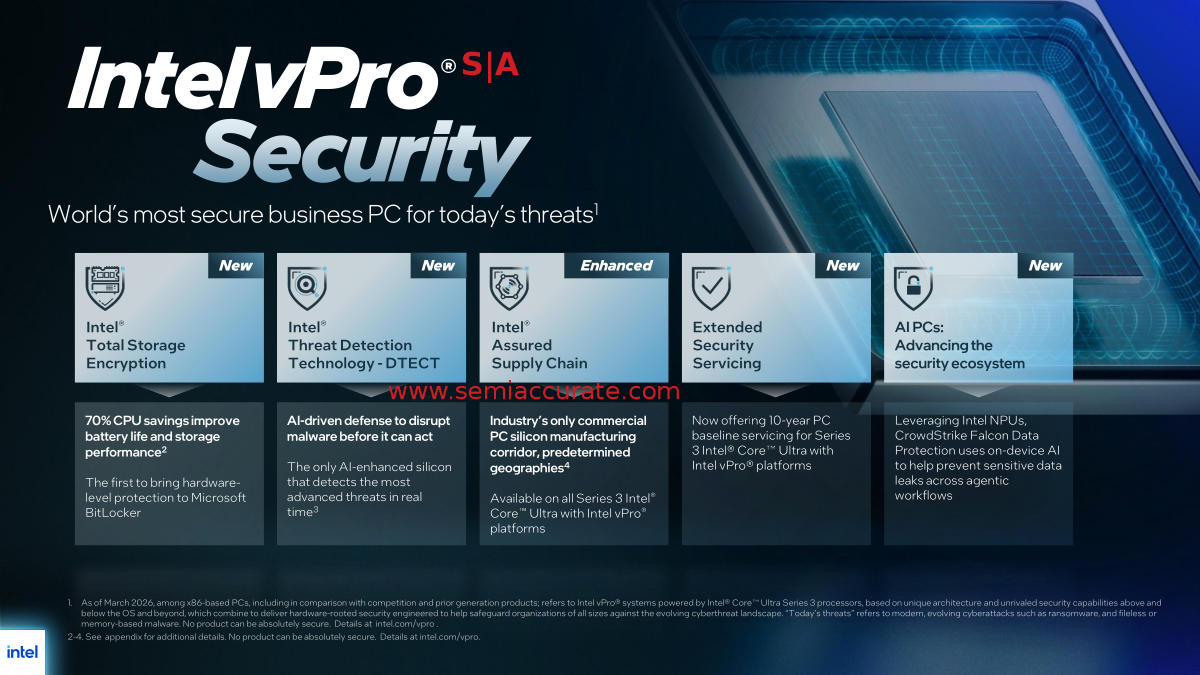
Intel vPro security high points
Security is the last pillar and there is some real good news here. The first chunk of Security is the Total Storage Encryption which ties into BitLocker. This is a good idea and having IT ops able to poke around and fix BitLocker using systems could be a godsend in some circumstances. The problem is that BitLocker itself is… err… problematic at the best of times. You don’t need to do an extensive search to find a plethora of problems with BitLocker that result in total system data loss, little unrecoverable ‘hiccups’.
If vPro can help with that, great, but the fundamental problems remain. Having an bomb strapped to your chest is not a positive event, but if IT can remotely peek at the timer, you will probably feel better, right? Couple this to the remote backdoor that is Pluton, something Intel did by far the best job mitigating, and you have hilarity waiting to happen. vPro can help but again, why not just avoid the problem in the first place?
TDT-DTECT or Threat Detection Technology is really useful and despite it being Windows only for the moment, could be a good thing. Previous versions of this tech took a processor trace and shunted the data to another core or GPU in real time to basically do signature based malware detection. About a decade ago we saw the rise of malware that morphed it’s code to avoid such things. Think instead of doing a hypothetical Add 1 you do a Subtract -1 and break the signature that is being looked for.
AI had made doing such things on a mass scale much easier and the tools to detect the result have had a hard time keeping up. There are a bunch of solutions that will send suspicious code/trace to a cloud based solution for analysis but that is far too slow in the modern world. TDT takes that same trace and sends it to another core for analysis based on AI that can, theoretically, see that morphed code is the functional equivalent of the original. If they ever support adult OSes, this will be very useful.
SemiAccurate considers the last three items pretty minor for most users but some may find them indispensable. Assured Supply Chain isn’t tracking like some people think, it is simply that you can specify which geographies your parts come from and have Intel certify that they really do. One look at the news of late will make you understand why this matters. Same with the Extended Security Servicing, a promise of 10 years of security updates for Panther platforms. Nice to have and the updates will keep coming long after the hinges on your laptop fail. Don’t ask why I chose that analogy. Then there is the use of the NPU for security by various OEMs. If an OEM uses this block, great but we don’t see why it is conflated with vPro.
Overall the new Panther vPro CPUs, Arc Pro GPUs, and vPro launches are a worthy addition to the program I launched for Intel two decades ago. The hardware is solid, should Panther hit the market in volume soon, it will be the clear non-server CPU for 2026. Arc B65 and B70 build on a good thing that Intel has achieved with their GPUs of late, if they keep it up good things will come from this line. Last up is vPro itself and that is a really mixed bag. The ideas behind it are good but they are so tied to Windows that they are effectively a moot point. Unbreaking things in a software layer above the break is rarely a fruitful exercise. All this said the hardware is really good and vPro won’t hurt and could occasionally help. Nice to see my baby grow up.S|A


Charlie Demerjian
Latest posts by Charlie Demerjian (see all)
- Intel Celebrates vPro 20th Anniversary With New Hardware And Software - Mar 25, 2026
- Anritsu Has The Nicest Testers At MWC - Mar 16, 2026
- Xerendipity Shows Off Stick-On Vapor Chamber - Mar 13, 2026
- AI PCs Have Failed Miserably, Can We Just Admit It? - Mar 11, 2026
- Adata Shows Off Quad-Ranked DDR5 CUDIMMs At High Speed - Feb 13, 2026
