 On Tuesday, Qualcomm lifts the embargo for their Snapdragon X2 Elite CPUs, brace yourself. SemiAccurate isn’t embargoed on this because Qualcomm doesn’t want anyone honest reviewing them.
Officially the review/benchmark embargo for the new X2 based systems lifts on Tuesday April 7, late morning EST, but that isn’t a big deal. What is a bigger deal is that if you were honest about how terrible the first Snapdragon X Elite systems were, you are cut out of this one. Guess what? TLDR: They didn’t even brief us much less offer us a sample this time, but we are not surprised.
As a recap we have had two different Elite X systems, a Surface and a Acer. Neither worked, and we mean that on a fundamental level. After about 16 months we could finally get the Surface to a stable desktop but some little niggles remained. By that we mean no sound, no net, and no mouse or keyboard. Oh yeah, it would crash if you moved the mouse wheel on an external mouse, but that is common for all PCs, right? The Acer was MUCH better but still not close to functional, these things are not PCs, not close, and not functional devices.
Lets take a little aside. Last summer I started asking people, “What is a PC?“. These people were engineers, journalists, enthusiasts, and silicon company executives including several at Qualcomm. There is no right answer, I just wanted to see what people said, and most of the answer clustered around either form factor, IE keyboard and large screen, or runs Windows. Both understandable.
The Bluesky post linked above had the best answer that I think is definitive from @giovani1906.bsky.social who said, “I think a PC counts anything that has an open bootloader by default which lets you load whatever OS you want. So most computers. Be it a laptop, handheld, Apple Macs, single board computers, etc. would fit that category while consoles, majority of phones and other locked down stuff would not.” Hard to argue that one, pretty simple, comprehensive, and verifiable. To me, that is a PC.
To me, and any other non-biased observer, the crap that Qualcomm and Microsoft are putting out in the form of WARTbooks are not. They are hard locked down by design, have intentionally locked down and obfuscated drivers, and no documentation. The software enablement done by Qualcomm is an embarrassment, a trick considering how little was actually done, and no one seems to care about the problem internally. This is the long way of saying don’t expect things to get better. Ever.
So for the X2, what are we expecting? Personally I was expecting it to be in much better shape than the X1 system but, well, Qualcomm’s handling of things tells me in no uncertain terms that, to use the vernacular, “shit’s still broke”. Why do we say this? Because if it worked, we would have been briefed and had a system with the rest of the reviewers like we asked them for months ago.
Before anyone not in the press comments something like, “You are just pissy because you didn’t get a laptop”, that is the furthest thing from the situation. Getting a device is a lot of work to test, probe, and write up. The reviews never are worth the time plus installing, reinstalling, and debugging pre-release hardware and drivers is not fun. OS installs are boring the first time, by the 17th they are…. awful. The only reason we wanted one to to test is to be able to say, “Qualcomm fixed the crippling, showstopper bugs the X1 had”. Or not. In this case Qualcomm did the work for us, so, err, thanks? In any case by not even notifying us, we are not embargo’d, NDA’d, or otherwise silenced, so again thanks.
So the X2 is unlikely to solve the X1’s problems. What are those problems? First and foremost is compatibility. A close relative was briefed by Dell and Microsoft in late 2024 and the pitch for the X1 laptops was that it had “82% compatibility with x86 software”. When he asked for the slides to read the fine print on what that 82% represented, they said no. This was for an IT organization at a major international engineering firm mind you, denying their IT departments basic info in a pitch meeting is a very bad idea. That said the 82% is undoubtedly better now but still nowhere near good enough. And it isn’t going to improve much.
Why do we say that? Two reasons. First is that the silicon team who did the hardware and x86 compatibility is literally the same architects who did the Mac M1 and M2 which have far better x86 compatibility. When asked at several Qualcomm events, every silicon engineer we talked to said the same thing, it isn’t the hardware. What could it be? Go back and look at what we said about software enablement again…
Then there is the real problem, Qualcomm fundamentally doesn’t understand what you need to do to make a PC. We have told them again and again but the derisive responses and lack of change tells us that they don’t care about fixing anything. So do the sales results for that matter, Qualcomm keeps doing the wrong things for the wrong reasons with the same own goal results.
The biggest tell was during the technical briefing on the X2 when Qualcomm engineers crowed that their game compatibility was way up. It truly is, and much of this is because they personally rewrote the kernel level Epic anti-cheat software for ARM. At this juncture I pointed out that what they did wasn’t compatibility, it was a rewrite of code that is likely good only for a single piece of hardware and will likely break with the next OS or Epic code revision. They argued back that it was compatibility.
What can you do at this point? Well you can discretely ask in a non-group session how long they are going to maintain the codebase for? And how quick are they planning to be to release updates after the x86 version drops, games are notorious for needing the latest anti-cheat code for obvious reasons. There was no answer. Qualcomm just doesn’t understand the term ‘compatible’ for this and many other reasons, it most emphatically does not mean ongoing point fixes.
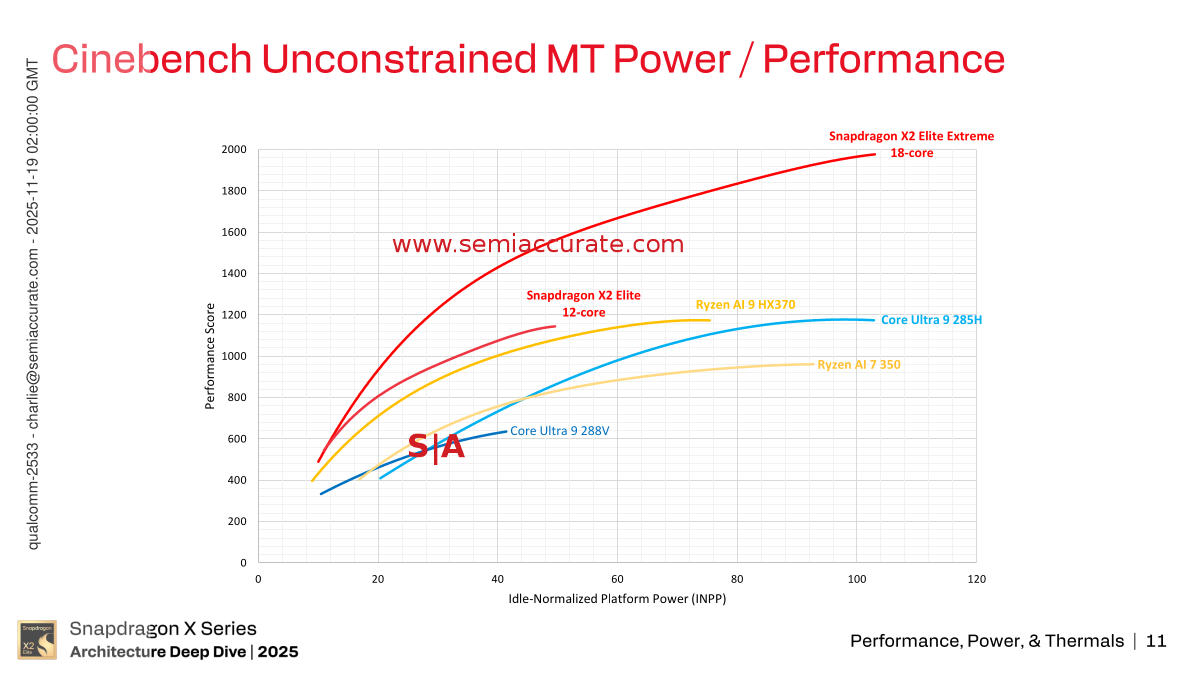
Then there is power. SemiAccurate has a LONG screed about Qualcomm’s over the top desperation to try and hide the power use of the X2. The short story is that their new metric, INPP, is not a measure of CPU power, nor is it a real measure of anything other than comparing two very similar systems. It would be good for measuring the difference in power between an X2 with on-package LPDDR5 vs one with on board LPDDR5 for example, but not for measuring things between two systems. And you can game it with ease.
When asked repeatedly for TDP or similar power draw metrics, Qualcomm said they had them and would provide them. They didn’t. At least they didn’t to journalists, OEMs got the numbers for some reason, and they were given TDPs not INPPs. Imagine that. For the record we were told the TDP for the top X2 elite was 85W for the version with LPDDR5 on board, 65W for the CPU alone. Now you see why they hid it? Compare that to a Panther Lake or AMD CPU and guess what?
Complete BS numbers but still illustrative
Worse yet is the biggest problem that they face, physics. The X1 had an anemic GPU that didn’t rise to the level of unacceptable. Playing older, casual games at lower resolutions with technically acceptable frame rates is not a win even if Qualcomm crowed about it. The X2 appears to have a vastly more capable GPU even if we weren’t allowed to benchmark it independently, more on that in a bit. In any case the X2 silicon is much closer to a real PC CPU even if the products it ends up in are abjectly broken.
The problem for Qualcomm is simple, when you get your features and performance up to the standards of x86 hardware, your power draw goes up to the same level too. Imagine the coincidence? As you can see from the graphs above, when you are using a BS metric like INPP that is literally designed to show your products in a good light, your products look good. Again with that coincidence. When you have to talk real numbers like TDP, well your products don’t look so hot. Reviewers who know this and are likely to test it don’t get samples. Could this again be coincidence? You decide.
Sticking with that theme we come to benchmarking. Again Qualcomm simply does not understand what they are doing and why it makes them look so bad and dishonest. What are we talking about? During the X2 briefs Qualcomm let us ‘benchmark’ X2 devices. By benchmark devices we mean there was a room with ~30 laptops, each with one of about 10 valid industry standard benchmarks installed. The benchmarking options were to press a button and wait for the result. Check settings? Nope. Change settings? Nope. Use a benchmark not preinstalled by Qualcomm? Nope. Check that the benchmark installed was not custom/optimized/tampered with code? Nope.
Not surprisingly the numbers that came up were very much in line with the results Qualcomm said we would get. Did they cheat? Probably not, but I can’t say that for sure. This wasn’t benchmarking, it was a demo session. If you ask too many questions or are willing to say things that don’t show Qualcomm in a good light, you don’t get to pass go or receive anything from that point onwards. Qualcomm only wants good reviews and knows how to get them. Instead of changing their ways to do the right thing, they ignore the problem and shoot the messenger.
So where does that leave us for the X2? SemiAccurate honestly had high hopes for the new CPU, the biggest problem, the lack of ACPI, is said to have been fixed. Unfortunately Qualcomm’s inability to understand what they need to do to compete in the PC market means they are unlikely to ever get there. This is a pity but actions speak louder than words. As we keep telling them, when we don’t get the information to write about the tech, the story becomes about you. I am personally sick of beating this dead horse but it can make a satisfying sound every once in a while.S|A


Charlie Demerjian
Latest posts by Charlie Demerjian (see all)
- Qualcomm Snapdragon X2 Review Embargo Lifts Tomorrow Morning - Apr 6, 2026
- Intel Cuts HDR OLED Panel Power with SmartHDR - Apr 2, 2026
- ASBOtech Makes A Real-World Useful Smart Ring - Apr 1, 2026
- Why Does Clearwater Forest Have Two PCBs? - Apr 1, 2026
- Intel Celebrates vPro 20th Anniversary With New Hardware And Software - Mar 25, 2026
