 At the launch of the Qualcomm X2 Elite CPUs, they avoided talking power like the plague. SemiAccurate finally has figured out why, and it was for ‘good’ reasons.
If you recall, during their technical brief on the X2, Qualcomm was unusually firm about not disclosing the power used by their new CPU. Instead they made up a new metric called INPP or Idle Normalized Platform Power. When asked about the TDP of the CPU, Qualcomm responded with various BS answers about how TDP was no longer relevant, they didn’t have the numbers, or they would get back to us. They never did get back to us mind you, and the thought that the people designing the SoC didn’t know the power consumed is a bigger joke. Instead we got things like, paraphrased, ‘there are two types of reference devices, a 20W system and an unlimited wattage system’. When asked what that meant, there was nothing we would qualify as a relevant response.
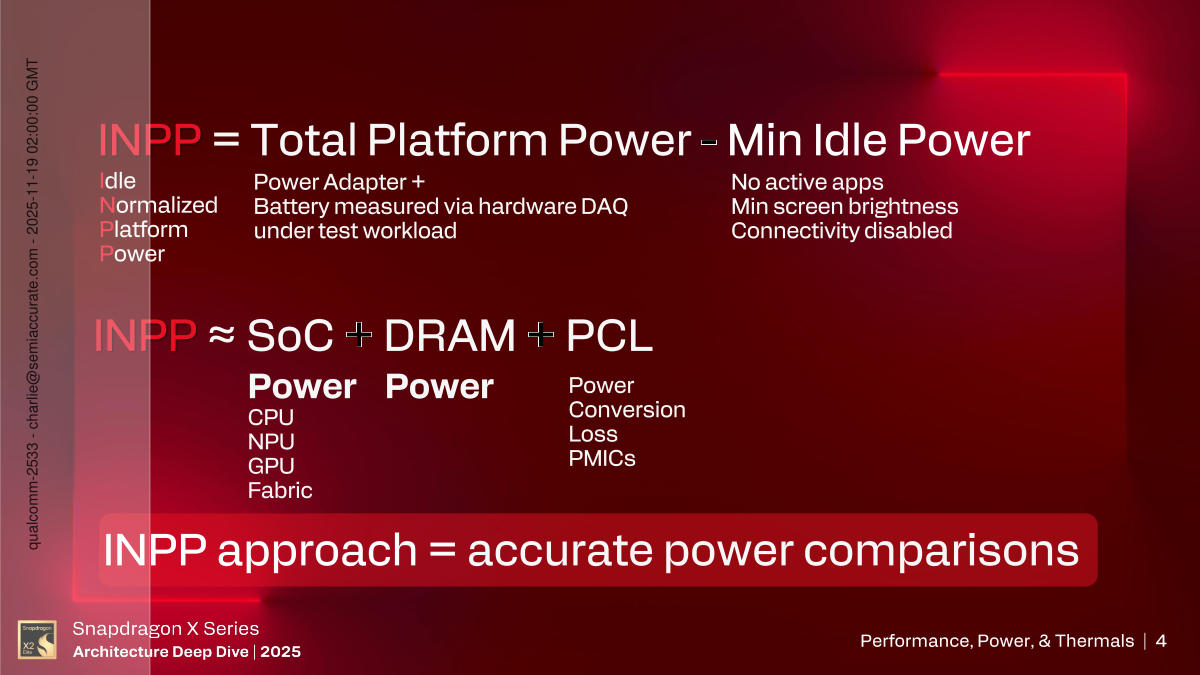
INPP ‘explanation’ doesn’t hold
To rehash our earlier problems with INPP, the short version is that it tells you NOTHING about the power consumption of the CPU, it is just about the system. Even then you can easily game it, if you look at the slide above, it measures load power minus idle power which does have uses but not for looking at components like a CPU. It is almost as if Qualcomm has a big problem they want to hide. HINT: They do. Essentially INPP is a metric they hope you will both misunderstand and wrongly conflate with TDP.
Back to the gaming bit. Imagine you build a system with golden sample components to send to reviewers like, oh, most companies did back in the day and probably still do to a lesser degree. Idle will be about the same as normal parts, possibly a bit higher but max draw will be lower so INPP will look really good. Compare a LPDDR5 system to a DDR5 system and the CPU draw is almost lost in the noise. Worst of all, go into the BIOS and set the idle clocks to a high point, then measure INPP. The number will be fabulous, unrealistic and totally gamed but looks good on paper. INPP is a joke that is useless in the real world, trivially gamable, and only meant to cover a bad number that Qualcomm doesn’t want out.
How bad is it? Intel engineers will be very happy when they see this because it destroys Qualcomm’s main CPU talking point, battery life, questionable though it is in reality. Please do note that the Qualcomm X Elite CPU is not a correctly functioning PC product which may or may not be the case with the X2. That aside, off we go.
Note: The following is for professional and student level subscribers.
Disclosures: Charlie Demerjian and Stone Arch Networking Services, Inc. have no consulting relationships, investment relationships, or hold any investment positions with any of the companies mentioned in this report.


Charlie Demerjian
Latest posts by Charlie Demerjian (see all)
- Intel Celebrates vPro 20th Anniversary With New Hardware And Software - Mar 25, 2026
- Anritsu Has The Nicest Testers At MWC - Mar 16, 2026
- Xerendipity Shows Off Stick-On Vapor Chamber - Mar 13, 2026
- AI PCs Have Failed Miserably, Can We Just Admit It? - Mar 11, 2026
- Adata Shows Off Quad-Ranked DDR5 CUDIMMs At High Speed - Feb 13, 2026
